Tuesday, 22 October 2013

A welcome break from wader watching... a pelagic!

I haven't had much luck with pelagics over the years. I am not the best of sailors and the thought of hours at sea do not apeal to me. I was on the very first Chalice trip to the "Wilson's Triangle" NOT to see the Wilson's Petrel, leading to us all wearing our free badge upside down for a while. I then went on one of the early Scillonian III pelagics that were having some success with the Wilson's, but again no luck. I have been on a couple of whale watching trips in the USA and Australia, and not seen a single cetacean, so you can see, I'm not that lucky on these trips. I was delighted then to find that the Kaikoura Albatross Encounter trips in New Zealand were right along our Wader Quest route and they only go out a mile or so and get surrounded by birds. Sounded good to me, and so it was!

We nearly didn't go because of fog, but eventaully it was decided the trip could go ahead and Elis and I were joined by  Kathy Hughes who works for the WWF and off we went. We ploughed through the seemingly constant stream of Hutton's Shearwaters as we left the harbour and headed out to sea.

The first bird we came acros loafing randomly on the sea was a superb White-capped Albatross (once a subspecies of Shy Alabatross).
White-capped Albatross.: Thalassarche steadi.

Soon after we encountered a small fishing boat that had attracted hundreds of bird, we stopped the engines and placed the bait over the stern of the boat. This was a new thing for me, no more horrible, gut-turning, oily chum, just a small cage with fish livers in it that didn't trouble the nose of even this delicate sailor.
Feeding flock of seabirds.
Little and large: Northern Giant Petrel and Cape Petrel.

We were soon surrounded by birds, we hardly knew where to look first. Perhaps the most obvious by their numbers were the Cape Petrels. This is a bird I had long desired to see and here I was now surrounded by them, I think I prefer the other names like Cape Pigeon or Pintado Petrel, but the bird can't be beaten, fantastic.
Cape Petrel, Cape Pigeon, Pintado Petrel, take your pick: Daption capense.

The noisiest and certainly the most beligerent of the birds were the Northern Giant Petrels, told from the Southern by the dirty brown bill tip which is green in the latter species. These bird squabbled and fought noisyly the whole time and at times would display agression by raising their tails and fanning them, stretching their head forward, spreading their massive wings and charging!
Northern Giant Petrel: Macronectes halli

Boistrous youngsters

Adult Northern Giant Petrel. Note the brown bill tip. As the birds get older they
get lighter and their eyes go from brown to whitish.

There were a few Westland Petrels that came and sat around the boat and we had one fly-by Fairy Prion.
Westland Petrel: Procellaria westlandica.

But the stars of the show undoubtedly were the five species of Albatross we saw up-close-and-personal. We saw more of the White-capped...
White-capped Albatross

some of the most attractive Salvin's Albatross, another split from the Shy Albatross whose subtle grey head colouring was set off by the eye and bill marking was so striking.
Salvin's Albatross: Thalassarche salvini.

Salvin's Albatross.
There was one Black-browed Albatross that put in an appearance...
Black-browed Albatross: Thalassarche melanophrys.
a single Royal Albatross, identified by the black line on the bill where the mandibles meet...
Royal Albatross: Diomedea sanfordi or epomophora.

and the most agressive and rapacious of all the Wandering Albatross.
New Zealand Wandering Albatross: Diomedea antipodensis.

We enjoyed this spectacle for some time and then set off to return home, this gave us the chance to see some of the species at their best, in flight.
New Zealand Wandering Albatross.

Salvin's Albatross

Salvin's Albatross

Salvin's Albatross.


Friday, 18 October 2013

Some southern African LBJs.

Not every bird in Africa has bright gaudy plumage. There are many, many Little Brown Jobs that are there to upset and confuse the unwary, here is just a small selection for your enjoyment.(?)

Non-breeding Black-chested Prinia Prinia flavicans: Parys, Free State Province, South Africa.

Rufous-naped Lark Mirafra africana: Parys, Free State Province, South Africa.

Levaillant's Cisticola Cisticola tinniens: Noordhoek, Western Cape Province, South Africa.

Karoo Prinia Prinia maculosa: Noordhoek, Western Cape Province, South Africa.

African Pipit Anthus cinnamomeus: Colesberg, Free State Province, South Africa.

Red-capped lark Calandrella cinerea: Colesberg, Free State Province, South Africa.

Large-billed Lark Galerida magnirostris: West Coast National Park, Western Cape Province, South Africa.

Spike-heeled Lark Chersomanes albofasciata: Colesberg, Free State Province, South Africa.

Sickle-winged Chat Cercomela sinuata: West Coast National Park, Western Cape Province, South Africa.

Kalahari Scrub-Robin Erythropygia paena: Elephant Sands, Central District, Botswana.
Barred Wren Warbler Calamonastes fasciolatus: Elephant Sands, Central District, Botswana.

Red-billed Quelea Quelea quelea and a single male Cut-throat Finch Amadina fasciata: Elephand Sands, Central District, Botswana. We only discovered the Cut-throat Finch when we checked the photos, so that's another one that Elis has got on me! Bah humbug!

Rattling Cisticola Cistocola chiniana: Elephant Sands, Central District, Botswana.

Grey-backed Carmaroptera Carmaroptera brevicaudata: Lawndon's Lodge, Ngamiland District, Botswana.
Your gues is as good as mine! Young Rattling Cisticola perhaps? Elephant Sands, Central District, Botswana.
Here's one that looks like an LBJ when it is running away from you, but quite stunning when it turns around.

Cape Longclaw Macronyx capensis: Parys, Free State Province, South Africa.

There now, wasn't that so much more rewarding than looking at pictures of colourful birds? Proper birder's birds these. Having said that, if you find any ID mistakes I'll not be surprised!

Thursday, 12 September 2013

Some stunners from Southern Africa.

Like any set of birds anywhere, there are always the bright, gaudy and downright retina burning examples, those that look like a kid has been let loose with a paint box and their imagination. Southern Africa has its fair share of such beasts, and here is a small selction for your delectation and delight, warning, you'd better get your sunglasses on in case!

Starting with a real gem, Malachite Kingfisher Alcedo cristata: Okavango River, Botswana.
How's that for exotica? Schalow's Turaco Turaco schalowi: Island View Lodge, Namibia.
There were a number of glossy starling species seen, this is Greater Blue-eared
Glossy Starling Lamprotornis chalybeus: Lawndon's Lodge, Botswana.
This large sunbird was the size of a small bee-eater, Malachite Sunbird Nectarinia
famosa
: Western Cape, South Africa.
 
Orange-breasted Sunbird Nectarinia violacea: Western Cape, South Africa.

Almost familiar; Cape Rock-Thrush Monticola rupestris: Western Cape, South Africa.

Nearly as bright as a Brazilian Tanager; Crimson-breasted Boubou
Laniarius atricoccineus: Elephant Sands, Botswana.
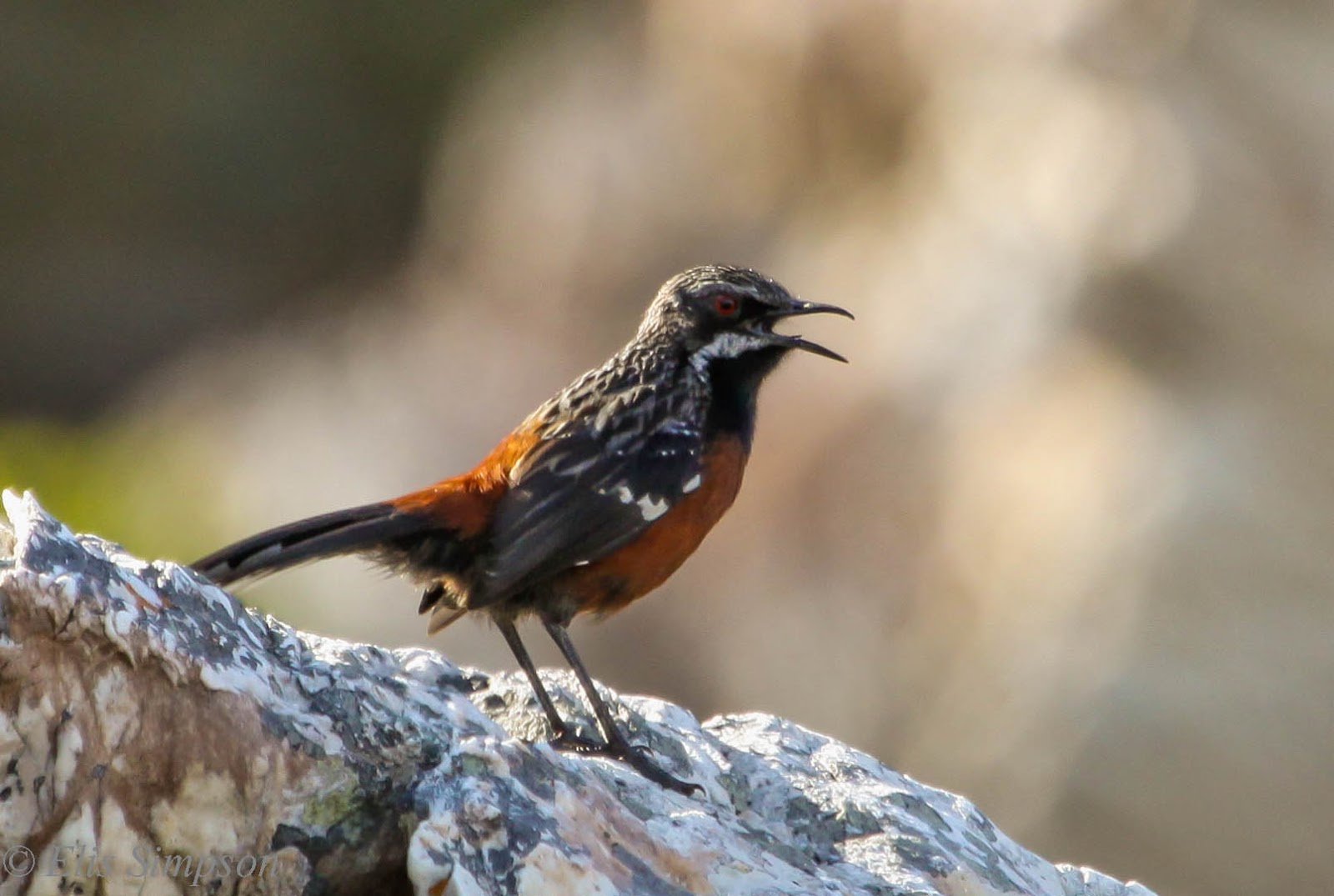
Possibly the most famous and sought after bird in South Africa, Cape Rockjumper
Chaetops frenatus: Western Cape, South Africa.

There are of course many more to come as and when we have time to process the 7,000 odd photos that Elis took on the trip, but we thought we'd whet your apetite with these to start with.

Wednesday, 11 September 2013

South African garden birds.

One of the joys of doing Wader Quest is that you get to visit some pretty cool places and see some pretty cool birds as collateral in the search for waders. Not that there is anything uncool about seeing Double-banded Courser, or Chestnut-banded Plover and especially not White-crowned Lapwing. But there is so much more to birding in southern Africa than this.

Garden birds can be pretty spectacular, here's a selection we saw in our friend Sue's garden on our first day!

Common Fiscal Lanius collaris: an unusual feeder bird.

Cape Sparrow Passer melanurus: makes our House Sparrow
Passer domesticus look a bit dull

Dark-capped Bulbul Pycnonotus (barbatus) tricolor
some split it, some don't; me? I don't really care it's a 
good looking, if common, bird whichever way you look 
at it.

Red-faced Mousebird Urocolius indicus: mousebirds are always fun, this 
was one of three species we saw.

A feeder with a difference, at least for us Brits! Southern Masked Weaver 
Ploceus velatus (top left male, front female), Cape Sparrow (Male top right 
and hidden, female bottom left) and Palm or Laughing Dove Stigmatopelia 
senegalensis.
Some more from the Garingboom Guest Farm gardens.

Red-throated Wryneck Jynx ruficollis.

Red-eyed Bulbul Pycnonotus nigricans.

Acacia Pied Barbet Tricholaema leucomelas.

Cape Turtle Dove Streptopelis capicola.
Possibly the most bizarre garden bird we saw was at Afton Grove, Noordhoek in the Western Cape.

Egyptian Goose Alopochen aegyptiacus.


.